
Big Picture
Tissues and organs are COMMUNITIES, so…
…the CohenLab learns the RULES and builds the TOOLS to control how large groups of cells move, heal, and grow.
Crowd behaviors are a common theme in all of our work because large groups of cells working together for things like healing a ‘cut’ follow the same kinds of rules as flocks of birds, road traffic, and large groups of people.
Sheepherding and urban planning are great ways to control large groups of animals! We use concepts from these fields to build new tools to make cells do useful things, like heal faster.
The longterm goal of our work is to use our understanding of collective cell behaviors to build new tools to help us heal faster.
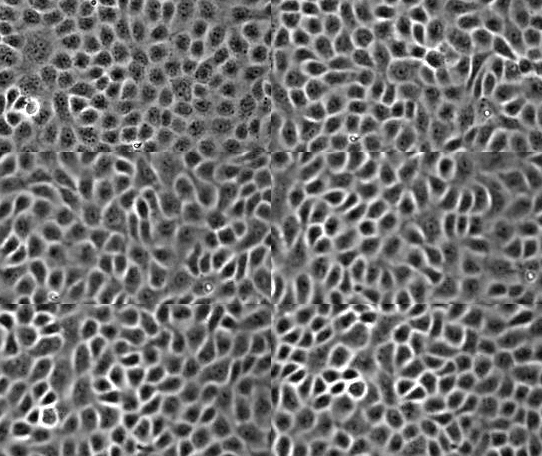
This shows a group of kidney cells ‘dancing’ in an electric field that we control. The electric field tells the cells to migrate either ‘left’ or ‘right’ and the cellular group follows the command. This is a tiny, zoomed-in view of a much larger cellular community with 50,000 cells. Imagine telling 50,000 humans (who are velcroed together) to do this!
Bioelectric 'sheepdogs' to herd cells and heal faster
Did you know that the first thing that happens upon cutting yourself is an electric current forms at the injury?
This is absolutely SCIENCE rather than science fiction, and it's incredible because these electric currents--formed by leaking salt ions (sodium, chloride, etc.)--actually help us heal. These natural electrical signals act like a navigational signal to surrounding cells saying “come here!” This even works during organ growth in 3D, such as in the kidney. And all of this has NOTHING to do with the brain!
Our lab is working to understand how we can make these signals better and use them to speed up healing, control organ growth, and develop new biological robots!
Secret cellular social lives
Tissues and organs really are cellular COMMUNITIES
That means we can use all sorts of tools spaning urban planning, swarm physics, road traffic, bird flocking, and more to understand the rules that groups of cells use to organize. We've even made our own version of ChatGPT that does AI for crowd behaviors and can learn the ‘rules of a cell crowd’ by giving it a movie to study!
The more we know about these rules, the better we can control healing, resist invasive diseases like cancers, and even grow tissues like skin grafts better.
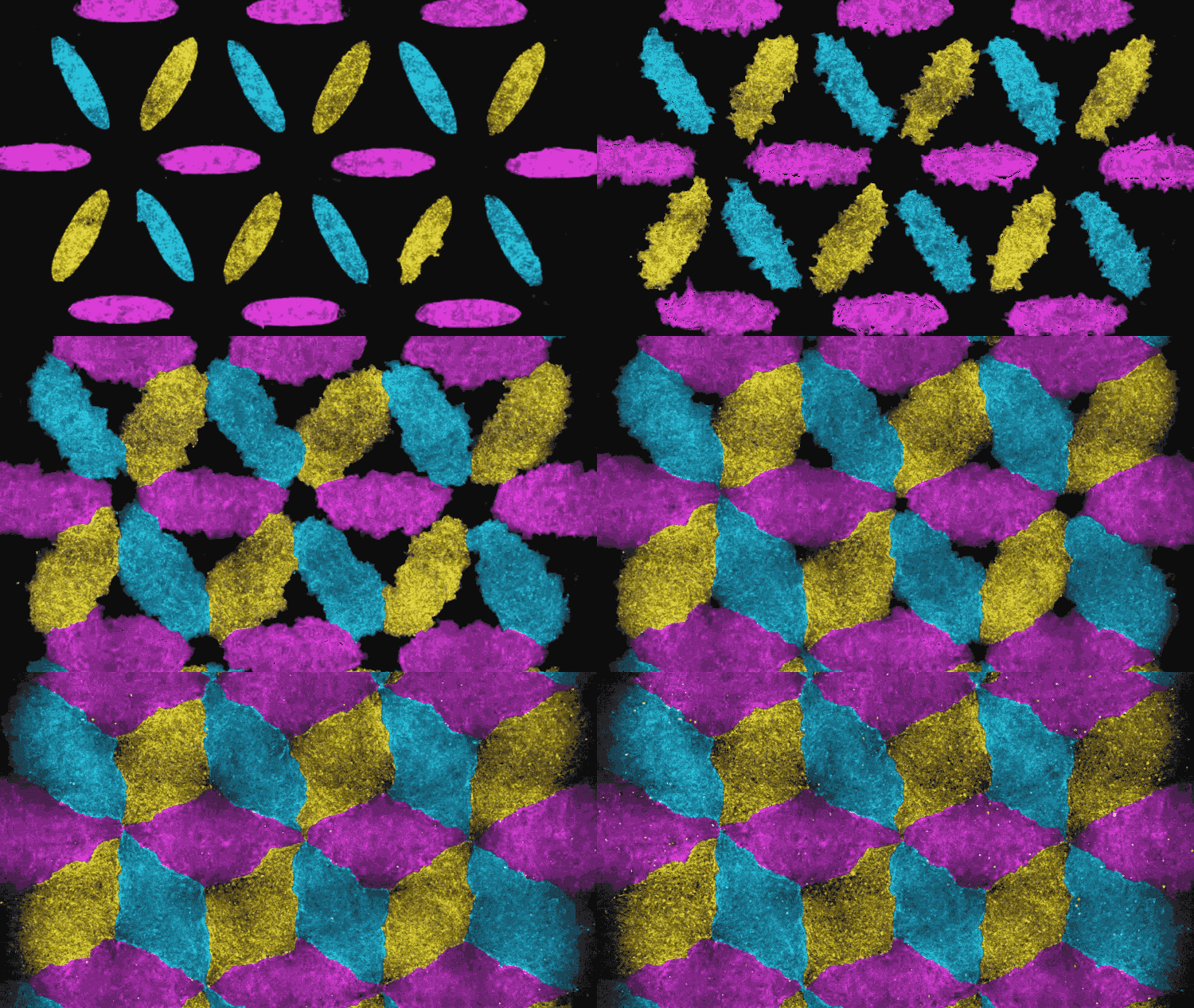
Inspired by how the artist M.C. Escher drew beautiful geometric patterns called tesselations, our team has used this concept to help individual tissue communities grow, collide, and heal into one super-community. The colors here just indicate different fluorescent dyes in each tissue, and the final resulting ‘quilt’ can be picked up out of the Petri dish and used in applications such as grafts and membrane biotechnologies.
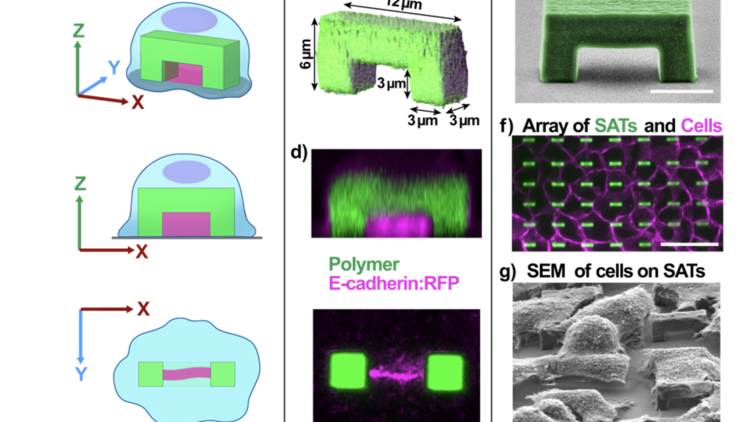
This picture is an example of a brand-new material we made that looks like an enormous array of tiny, tiny, tiny ‘arc de triomphes' that are smaller than individual cells. When cells touch these little arches, they wrap around them and wind up holding their own hands inside the tunnel, thereby improving how they attach to the material.
Cell-like biomaterials
Just like people, cells have ‘feet’ and ‘hand’ proteins. The ‘feet’ proteins (integrins) allow cells to run around on materials in our body like collagen. The ‘hand’ proteins (cadherins) are (in our opinion) a lot cooler--they allow cells to: recognize other cells; attach to each other; measure how hard neighbors are pulling; and communicate over long distances.
However, ALL medical materials for implants today try to give cells something for their feet-proteins to attach to. We've been working on a new kind of biomaterial that tricks cells into 'shaking hands' with the material to help improve the stability of medical implants in soft tissues like skin.
From toys to tools: MacGyver'ing cheap, powerful science tools
Science is expensive. What scientists have to do, from engineering replacement organs from scratch to spying on cancer cells invading in the body in real-time, requires incredible tools. Developing new tools to help with these things is critical, especially new tools that are less expensive and easier for more scientists to use.
Our lab specializes in solving our problems using low-cost, fast, powerful tools that we often repurpose from hobby tools and children's toys! Two examples are listed below.
- From Art Robot to Microsurgeon! One of the most common experiments for studying how tissues heal and how new drugs affect living tissues is to engineer a flat layer of cells and then ‘cut it’ to mimic an injury, followed by microscope videography to watch how it recovers. This is normally done by hand (slow, inaccurate) or by machines costing ~$10,000. We repurposed a $350 art robot meant to hold markers and paintbrushes and instead gave it a microknife and hacked it to quickly, cheaply, and programmably cut and sculpt living tissues!
- 3D→2D printing: Budget resin printers are pretty capable today. For $300 you can start printing incredibly detailed action figurines, dental molds, and more all using patterns of light projected onto a chemical that hardens when hit by light. We hacked a 3D printer and removed the ‘3D’ part, instead making it quickly create hard patterns of a chemical that repels cell adhesion. This lets us instantly pattern entire Petri dishes with precise, reproducible ‘molds’ for growing organoids and other tissues.
Skin/connective-tissue sculpted by an Art Robot!
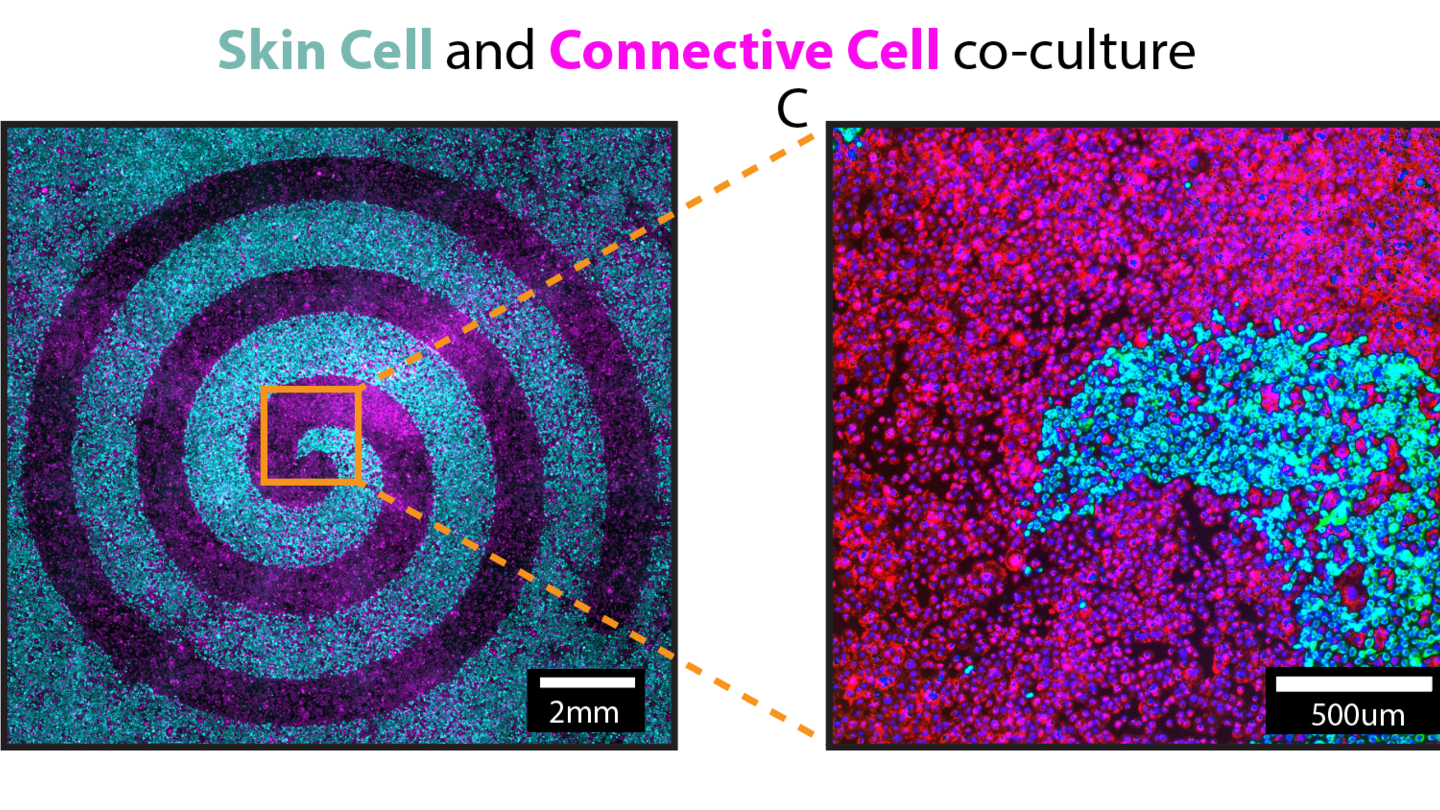
Here, we engineered a layer of skin (blue), then used the art robot to cut a spiral into it, then ‘back-filled’ that empty space with connective tissue (pink)!
Waterbears, ventilators, and more!
One of the most important elements of academic research is the ability to explore a range of different topics, pushing our understanding and capabilities forward and potentially enabling new and unexpected future tools.
We've worked in this area in a number of ways, and a few examples are discussed here.
- Waterbears! These are incredible creatures that can survive boiling, freezing, gamma radiation, and even space (without protection)! They're of enormous interest because they use special proteins to protect and heal themselves and if we can figure these out we'll have a range of new tools for human hibernation, tissue preservation, and healing. However, waterbears are also adorable and the smallest animal with legs, making them a great platform for future micro-robots. While we were studying their special proteins we actually collected enough video data of them walking to learn their secrets!
- Ventilators: We made a fully open-source, pediatric ventilator (PVP1) that can specifically help children with ventilation needs and costs only about $1200. Moreover, we worked with Google to develop a unique AI controller for it to improve its performance!
Waterbear walking!
